
The six fire classes, and what they actually mean.
Every extinguisher is tested against specific classes of fire, and the classes are about what is burning rather than where. Most commercial premises carry more than one, which is why one general-purpose extinguisher rarely covers a whole site properly.
Carbonaceous materials
Wood, paper, card, textiles and most plastics. The commonest fire in an office, a school or a storeroom, and the class a general-purpose extinguisher is built around.


Flammable liquids
Petrol, diesel, oils, paints, spirits and solvents. Common on forecourts, in depots, workshops and plant rooms, and the reason a site with fuel storage needs cover an office never will.

Flammable gases
Propane, butane, methane and similar. Handled by isolating the supply first wherever possible. Extinguishing a gas fire while it is still feeding can leave an unburnt explosive atmosphere behind.
Not a class, a hazard
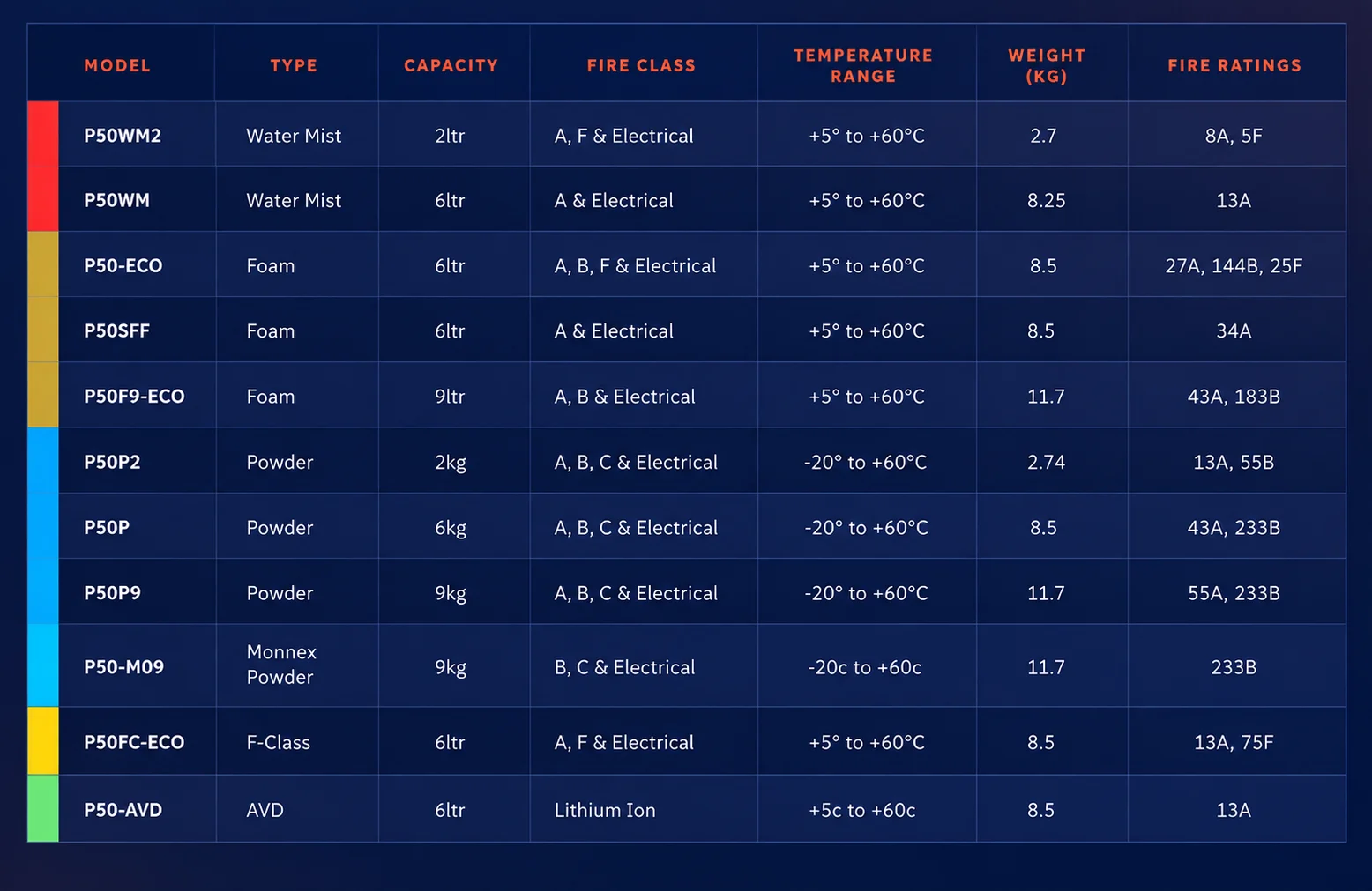
There is no "Class E". Live electrical equipment is a hazard that can sit alongside any other class. The models below are the selected representative sizes whose chart rows include electrical use.
Fats and cooking oils
Fryer oil and fats burn far hotter than a Class B liquid and reignite readily. For Water Mist, the 2L P50WM2 stays here because it is the Water Mist model on the chart with the Class F rating; the 6L P50WM is not Class F rated.

Lithium-ion battery fires
Lithium-ion is not Class D. The chart identifies the 6L P50-AVD specifically for lithium-ion risks.

Which fire extinguisher do you need?
Find the row for what can actually burn on your premises.
Most sites need more than one. A kitchen needs Class F and general cover, a warehouse with an EV charger needs foam and AVD. Match the row to the risk, then check the range page for the exact model.
The whole P50 range, in one brochure.
Every model in the Britannia P50 range with its fire ratings, capacities, dimensions, temperature range and approvals, alongside the servicing and twenty-year life-cycle detail. Useful when you are writing a risk assessment or putting a specification in front of a client.
If you would rather not work it out from the chart, we will walk the site, identify each risk by class and give you a written schedule of what goes where, with no obligation to buy from us. Covering Norfolk, Suffolk and Cambridgeshire, with UK-wide delivery.