
P50-AVD Lithium Battery Fire Extinguisher
Cool the cells. Stop it coming back.
A lithium-ion battery fire isn't a normal fire and doesn't behave like one. The P50-AVD carries an agent built for it: water to pull the heat out of the cells, vermiculite to seal the surface behind it. Also rated 13A and tested on live electrical to 1000V. Built in Norfolk by Britannia Fire, delivered and commissioned UK-wide by TristarFS.
What's The Best Extinguisher For Lithium-Ion Batteries?
Lithium-ion battery fires require a different approach from many conventional fires, because the cells can generate intense heat and may continue to fail after flames have been suppressed.
The P50-AVD is a specialist fire extinguisher for lithium-ion batteries. Its AVD extinguishing agent combines water with vermiculite to provide two important functions:
- Rapid cooling: draws heat from the battery
- Protective barrier: seals against re-ignition
Britannia Fire describes the P50-AVD as a tested and certified extinguisher specifically designed to tackle lithium-ion battery fires.
For businesses, landlords, facilities managers and property owners looking for a lithium battery fire extinguisher, the P50-AVD provides purpose-designed protection for modern battery-related fire risks.
Every e-bike in the hallway, every scooter on charge overnight, every laptop and power tool in the store cupboard is a battery that can fail. When one does it goes from nothing to violent in seconds, and the extinguisher someone grabs needs to be built for that, not the nearest red cylinder.
Water takes the heat. Vermiculite seals it.
Heat is the whole problem
A battery fire is driven by heat inside the pack forcing neighbouring cells into failure. Cooling isn't a nice-to-have here, it's the entire job. Drop the pack temperature and you interrupt the chain moving through it.
The layer that stays behind
As the water evaporates the vermiculite bonds into a protective layer over the surface, smothering flame and helping stop the fire re-establishing once the cooling effect has passed. It's the part that keeps working after the discharge stops.
13A and 1000V as well
Battery fires rarely stay confined to the battery. Britannia rate the P50-AVD 13A for Class A carbonaceous fires, and it has passed the EN3 test on live electrical equipment up to 1000V, so one unit covers the pack and the room it's in.
No extinguisher "stops" thermal runaway. Once cells are propagating, the reaction produces its own heat and its own oxygen and will continue until the energy in the pack is spent. What the P50-AVD does is cool and suppress: on a small, early-stage device fire that can be enough to put it out, and on a larger pack it limits spread and buys time. Anyone selling it to you as a guaranteed stop on an EV fire is overselling it.
Evacuate and call 999 first. Raise the alarm, get people out, and only tackle it if you can do so safely and have a clear way out behind you. Battery fires produce dense, highly toxic smoke very quickly.
Then assume it can come back. Re-ignition hours after an apparently extinguished battery fire is well documented, because heat held deep in the pack can restart the process in cells that hadn't yet failed. Anything involved should be isolated somewhere safe (ideally outdoors, away from anything combustible) and kept under observation. Never return a fire-damaged battery or device to a building, a bin or a vehicle.
Britannia designed the P50-AVD to work alongside their AVD fire blanket, and for premises with clusters of smaller devices the pair is a much better answer than either alone: the blanket goes over the device to contain flames and block radiated heat, then the extinguisher discharges under its edge to cool and finish the job. We supply the blankets in all three sizes. Ask at survey.
Twin magnet-tested indicators
Two independent pressure indicators, verified in seconds with the testing magnet stored in the base. Needle returns to green. The unit is live.
HDPE wound in Kevlar®
An HDPE core wrapped in aramid yarn with a UV-protected outer casing. It can't corrode or dent, which matters where these get sited: car parks, bike stores, loading bays and other places a steel body would quietly rust at the base.
6L Aqueous Vermiculite Dispersion
A water-based fluid carrying particles of vermiculite, a natural mineral: no fluorochemicals, safe for the user and safe for the environment, and fully recyclable at end of life along with the cylinder.
EPDM hose & nozzle
Fully recyclable at end of life
Built for the worst two minutes.

Your own staff are your engineer.

Check the indicators
Both pressure indicators should sit in the green segment. If either shows red, the unit goes back to us as your distributor.

Check the tamper seal
Confirm the seal and pin are in place. A missing seal means one phone call to TristarFS, not an engineer contract.
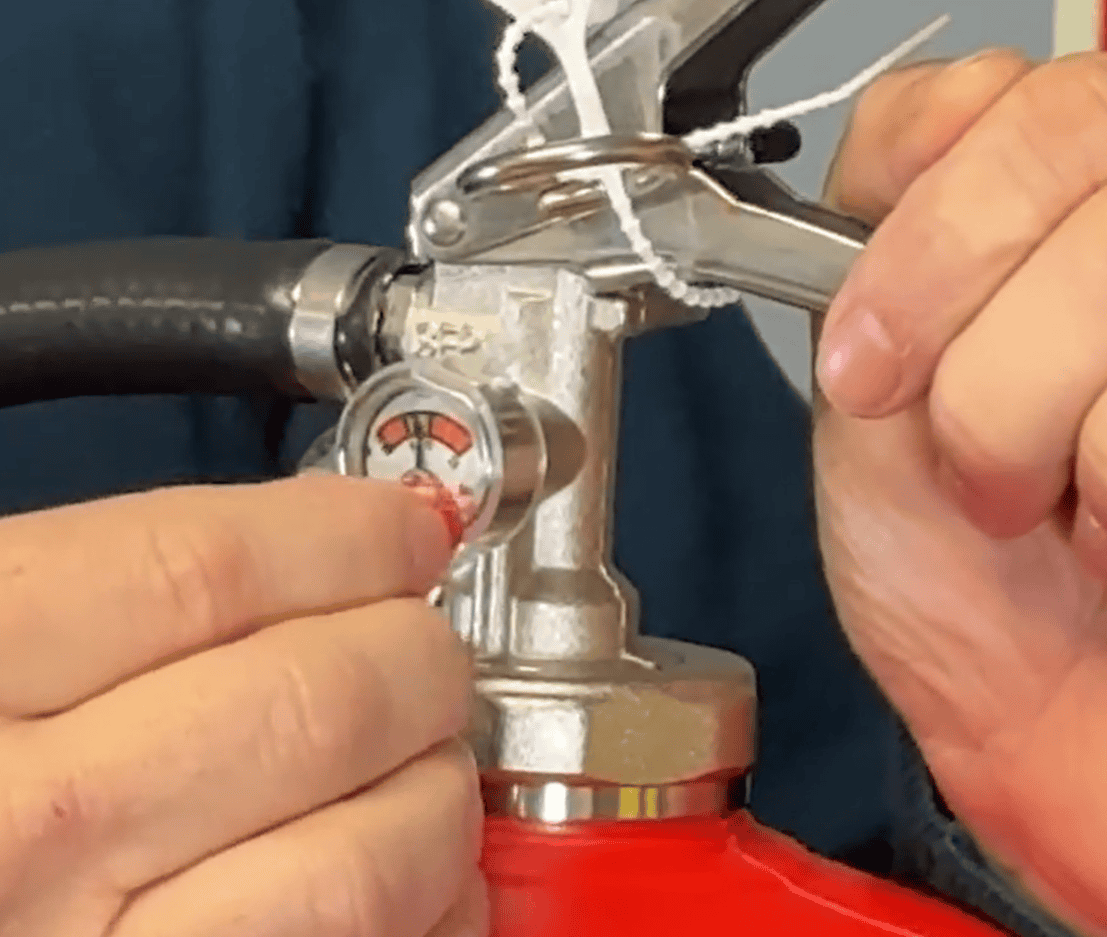
Run the magnet test
Wipe the unit down, take the testing magnet from the base and pass it across each indicator. The needle should move, then return to green.

Confirm the date
A colour-coded stud in the base gives the year of manufacture. At year 10, one manufacturer overhaul extends the lifespan another decade.

Log it
Record the inspection date in your fire logbook and mark the body. Done for another year.

A simple workplace check, not an engineer visit.
The annual P50 inspection can be completed and recorded by a trained member of your own staff, in about two minutes per unit.
Two minutes per unit. Once a year.
Every P50-AVD we commission comes with the logbook, staff walkthrough and written procedure for your fire risk assessment.
Book your free survey →The full data sheet.

Where Can You Use An AVD Lithium Extinguisher?
Lithium-ion risk follows the battery, not the building. These are the premises where it usually turns up, subject to the site’s fire risk assessment.
EV Charging & Car Parks

Charge points concentrate the risk in one place, often in an enclosed or underground car park where access is tight and a vehicle cannot simply be pushed clear. Siting cover at the charger rather than at the entrance is the point.
E-bike & E-scooter Storage

Bike stores, delivery depots and communal cycle rooms, where a dozen batteries are charged overnight in a space nobody is standing in.
Battery Storage & UPS Rooms

Standby power, storage racks and UPS installations. The room is usually unmanned, so what matters is that the right extinguisher is already inside it.
Warehousing & Powered Equipment

Forklifts, pallet trucks and floor scrubbers charged on a bay at the end of a shift: battery plant that sits alongside a lot of Class A material.
Workshops & Vehicle Repair

Garages and repair shops now handling EVs and battery packs, alongside the fuel, oil and combustible stock already on the floor.
UK Manufactured.
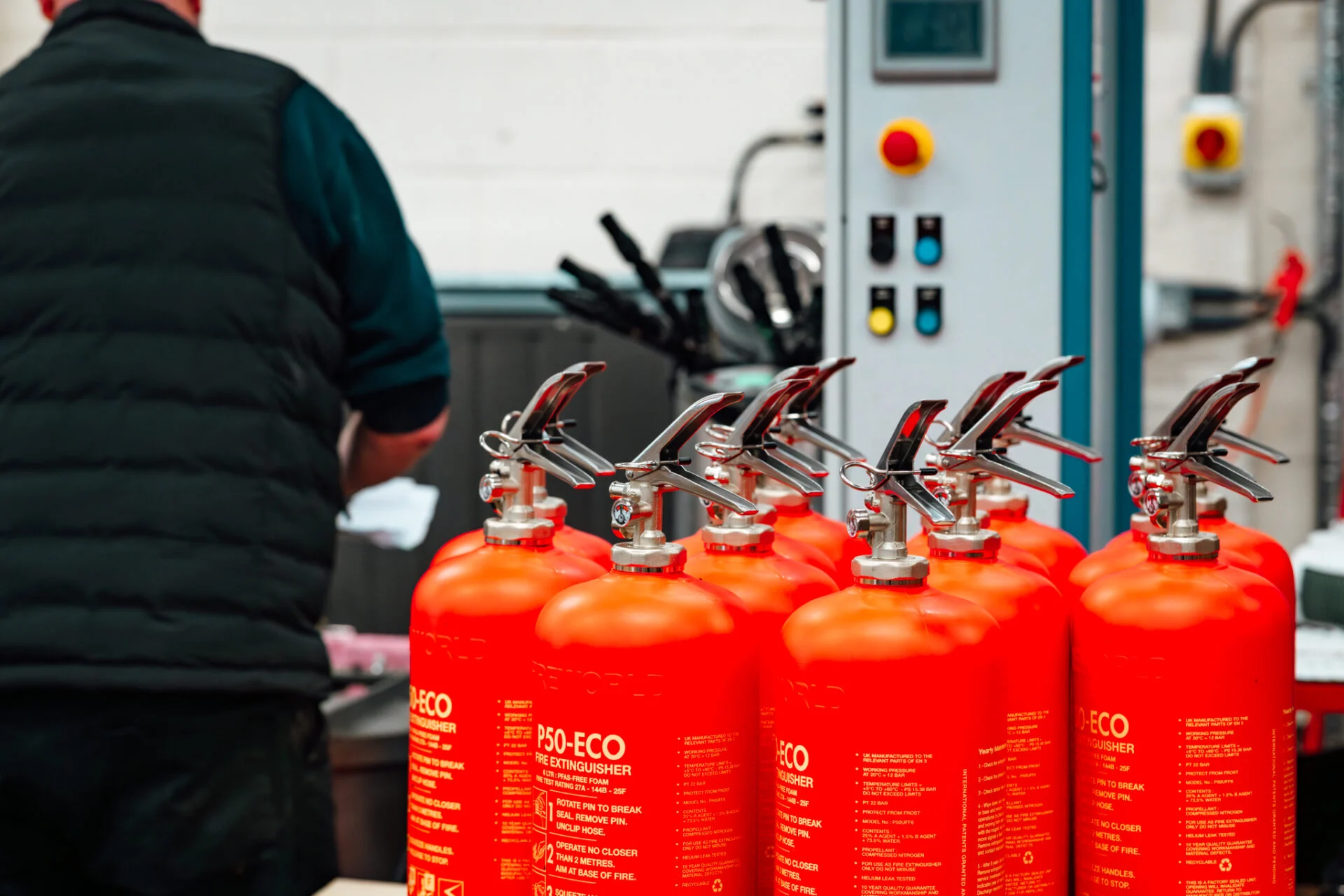
The P50-AVD isn't assembled from imported parts. It's designed and manufactured by Britannia Fire in Norfolk, England, and it's the newest addition to a composite range they've been building for over a decade. Every cylinder is wound, charged and tested before it leaves the factory floor.
Engineered in Norwich
Composite technology developed and refined by Britannia Fire, a British manufacturer, not an importer.
Every unit, before dispatch
Each cylinder is wound in aramid, pressure-charged and individually tested at the factory in England.
UK-wide delivery
Supplied anywhere in the UK by TristarFS, with siting and commissioning available nationwide.
The maths does the selling.
The purchase price is where a steel extinguisher's costs start. It's where the P50-AVD's stop, and battery risk is spreading across sites faster than most estates are re-specifying for it.
Ask before buying.
Straight answers on how AVD works, what an extinguisher can realistically do to a battery fire, siting, servicing and delivery. Anything we haven't covered, book a free survey and ask in person.

01What is AVD, and how does it work on a battery fire?
02Can an extinguisher stop thermal runaway?
03Is a lithium-ion battery fire a Class D fire?
04Can a battery fire re-ignite after it's out?
05Where should these actually go?
06Should I get the AVD fire blanket too?
07Does it need an annual engineer service?
08What else can I use it on?
Fit it. Forget it. For ten years.
Every P50-AVD from TristarFS arrives British-built, with the inspection procedure and logbook included and commissioning available UK-wide: whether that's one bike store or a whole managed portfolio.
Site surveys are free and without obligation