
Wet Chemical Fire Extinguisher Highest Class F rating, UK manufactured.
Seventy-five litres of burning oil. One unit.
The P50FC-ECO is a wet chemical fire extinguisher carrying a 75F rating, the highest Class F rating, seventy-five litres of cooking oil. It's the extinguisher a commercial kitchen needs, and it never sees a service engineer. Built in Norwich, Norfolk by Britannia Fire, delivered and commissioned UK-wide by TristarFS.
What Is A Wet Chemical Fire Extinguisher?
A wet chemical fire extinguisher is the only extinguisher rated for Class F fires, burning cooking oil and fat.
Applied through a low-velocity applicator, the agent lays a cooling, sealing film across the surface of the oil, cutting off the oxygen and dragging the temperature down below its re-ignition point. Water and CO2 extinguishers can't do this safely; a wet chemical fire extinguisher is purpose-built for exactly this risk, and it's a legal requirement in most commercial kitchens across the UK.
The P50FC-ECO takes this further: a 75F-rated, PFAS-free wet chemical fire extinguisher supplied and commissioned UK-wide by TristarFS, with no annual service contract required.
A fryer fire is the one your team will meet at the worst possible moment: mid-service, hands full, everyone else in the room. The extinguisher on that wall has to be the right one, has to be in date, and shouldn't depend on an engineer's diary to stay that way.
What 75F actually means.
It works on the oil, not the flame
Applied gently, the agent lays a sealing blanket across the surface of the burning oil. That shuts off the oxygen, but just as importantly it pulls heat out of the fuel and brings it back below the temperature at which it re-ignites.
Smothering alone isn't enough
Cooking oil holds an enormous amount of heat. A fat fire that has only been smothered will light again the moment the seal is broken or disturbed. Bringing the oil temperature down is what stops it coming back while the kitchen is being evacuated.
Tested to 1000V at 1 metre
A commercial kitchen is fryers, ranges and extraction packed close together, all of it live. The P50FC-ECO has passed the EN3 test for use on live electrical equipment up to 1000V at a distance of 1 metre.
Water and burning oil do not mix, violently. Cooking oil burns far above the boiling point of water. Water, or a standard water-based extinguisher, hitting burning oil flashes to steam instantly and throws the burning oil out of the fryer as a fireball. This is the single most dangerous thing anyone can do in a kitchen fire.
CO2 is the wrong tool too. The force of the jet can blast burning oil out of the container, and CO2does nothing to cool the fuel, so the fire re-establishes as soon as the gas disperses. Class F exists as a separate rating precisely because of this. If there is a fryer on site, a Class F unit is not an upgrade, it's the baseline.
Twin magnet-tested indicators
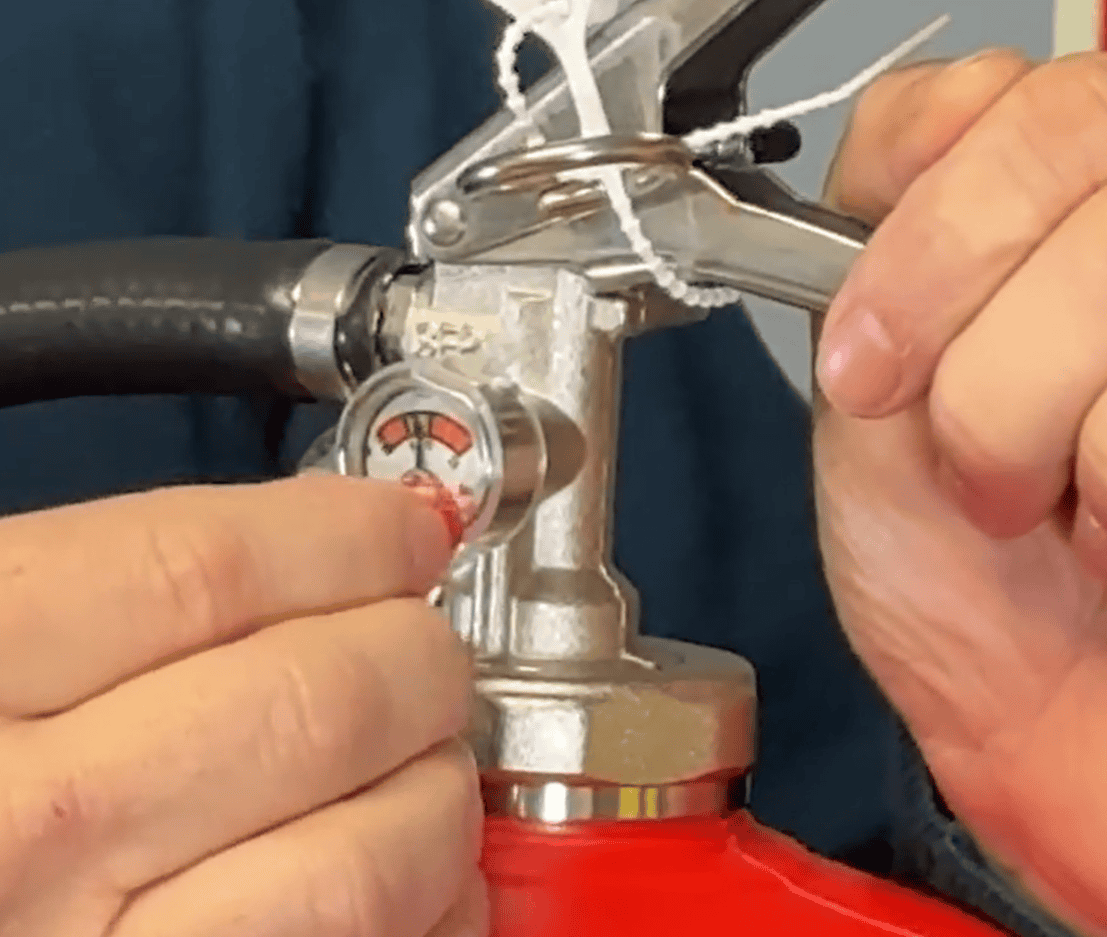
Two independent pressure indicators, verified in seconds with the testing magnet stored in the base. Needle returns to green. The unit is live.
HDPE wound in Kevlar®
An HDPE core wrapped in aramid yarn with a UV-protected outer casing. It can't corrode or dent, which matters in a kitchen, where steel bodies sat in warm, greasy, humid air are exactly what starts rusting at the base.
6L PFAS-free Class F charge
Rated 75F, and free of the fluorochemicals that put conventional firefighting agents on borrowed time. With PFAS restrictions tightening across the UK, specifying a PFAS-free wet chemical fire extinguisher now is what avoids a forced swap later.
EPDM hose & applicator nozzle
Fully recyclable at end of life
Built for the worst two minutes.

Your own staff are your engineer.

Check the indicators
Both pressure indicators should sit in the green segment. If either shows red, the unit goes back to us as your distributor.

Check the tamper seal
Confirm the seal and pin are in place. A missing seal means one phone call to TristarFS, not an engineer contract.
Run the magnet test
Wipe the unit down, take the testing magnet from the base and pass it across each indicator. The needle should move, then return to green.

Confirm the date
A colour-coded stud in the base gives the year of manufacture. At year 10, one manufacturer overhaul extends the lifespan another decade.

Log it
Record the inspection date in your fire logbook and mark the body. Done for another year.

A simple workplace check, not an engineer visit.
The annual P50 inspection can be completed and recorded by a trained member of your own team, a head chef or duty manager, in the time it takes to check the fridges.
Two minutes per unit. Once a year.
Every P50FC-ECO we commission comes with the logbook, staff walkthrough and written procedure for your fire risk assessment.
Book your free evaluation →The full data sheet.

Where Can You Use A P50 Wet Chemical Extinguisher?
Class F exists as a separate rating because cooking oil behaves differently from other fuels. These are the premises where that rating is usually required, subject to the site’s fire risk assessment.
Commercial Kitchens

Any kitchen with a deep fat fryer or a significant volume of cooking oil. Class F covers the fryer risk a general-purpose extinguisher is not rated for, and it belongs within reach of the appliance rather than by the door.
Restaurants, Pubs & Hotels

Front-of-house premises where the kitchen runs at volume through service. Multi-site groups typically specify the same Class F cover at every location.
Schools, Colleges & Care Catering

Catering kitchens serving a fixed roll every day, where the cooking oil risk is present however modest the menu is.
Takeaways & Mobile Catering

Takeaways, food trailers and event catering, where fryers sit in a confined space and the extinguisher has to be as compact as the kitchen.
Staff Canteens & Workplace Kitchens

Canteens inside offices, factories and depots. The catering is incidental to the business, which is exactly why the Class F rating is the one most often missed.
UK Manufactured.
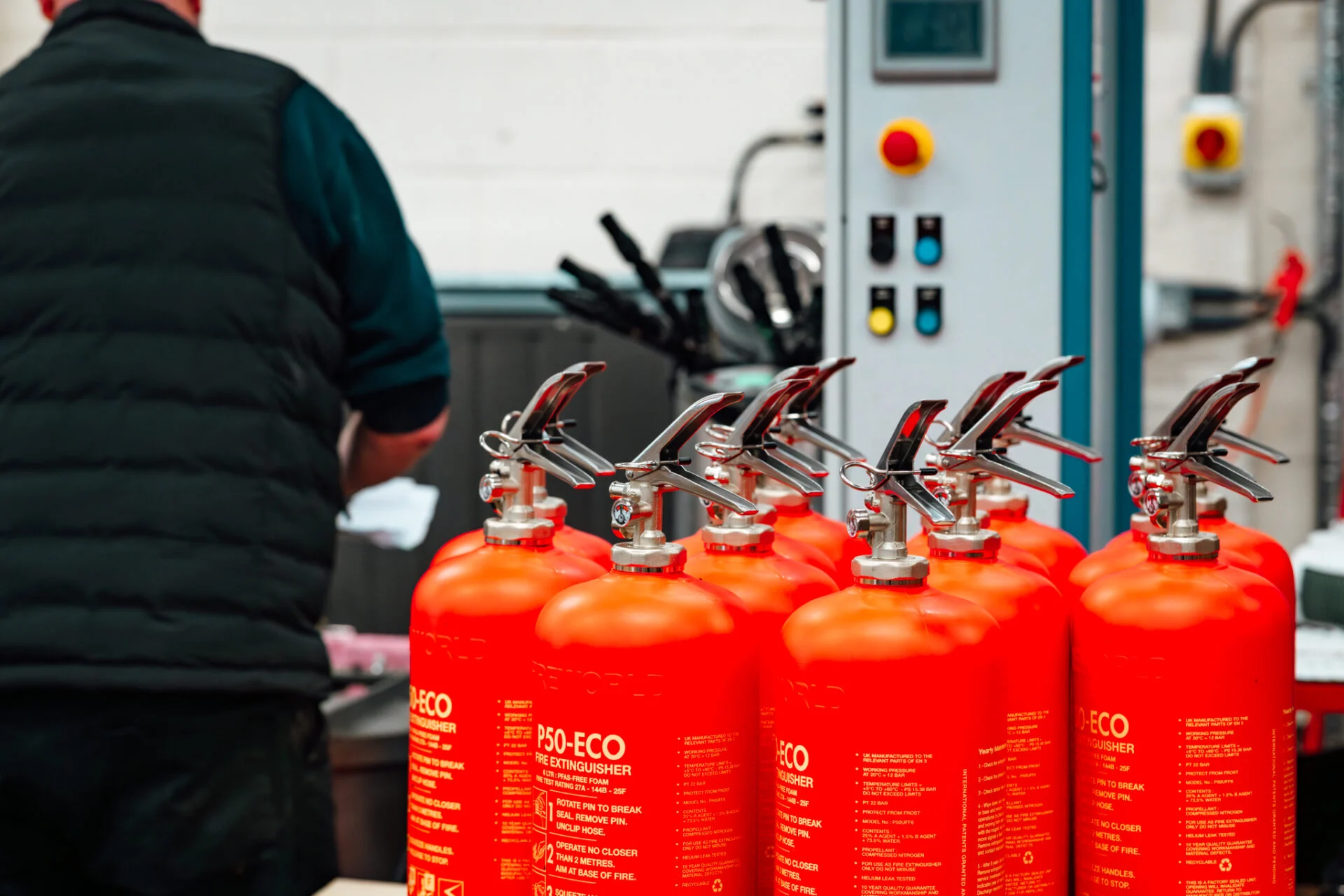
The P50FC-ECO isn't assembled from imported parts. This wet chemical fire extinguisher is designed and manufactured by Britannia Fire in Norwich, Norfolk. Every cylinder is wound, charged and tested before it leaves the factory floor, then delivered UK-wide by TristarFS.
Engineered in Norwich
Composite technology developed and refined by Britannia Fire, a British manufacturer, not an importer.
Every unit, before dispatch
Each cylinder is wound in aramid, pressure-charged and individually tested at the factory in Norfolk, England.
UK-wide delivery
Supplied anywhere in the UK by TristarFS, with siting and commissioning available nationwide.
The maths does the selling.
The purchase price is where a steel extinguisher's costs start. It's where the P50FC-ECO wet chemical fire extinguisher's costs stop, and in a multi-site restaurant or pub group across the UK, that gap compounds every year across every kitchen.
Ask before buying.
Straight answers on Class F ratings, what not to use on a fat fire, servicing, lifespan and delivery. Anything we haven't covered, book a free evaluation and ask in person.

01What does a 75F rating mean?
02Why can't I just use the water or CO2 extinguisher we already have?
03How does a wet chemical extinguisher put out a fat fire?
04Does it need an annual engineer service?
05Is it safe near live kitchen equipment?
06Do I still need other extinguishers as well?
07Is the agent PFAS-free, and does that matter?
Fit it. Forget it. For ten years.
Every P50FC-ECO wet chemical fire extinguisher from TristarFS arrives British-built, with the inspection procedure and logbook included and commissioning available UK-wide: whether that's one kitchen or every kitchen in the group.
Evaluations are free and without obligation